ChatGPT ads have been live in Germany since 24 August. We handle setup, feeds and campaign management. From day one.
The channel is open – and since 31 August also self-serve. Ads have been running in Germany since 24 August; since 31 August the Ads Manager can be booked directly from 31 European markets. We build the setup, context hints, product feeds and conversion tracking, and run your campaigns on CPC and conversions, not impressions. In the intro call we will also tell you if we would advise against your setup.
Yes. Since the European launch on 24 August 2026, ChatGPT Ads have been running in Germany too; since 31 August the Ads Manager can be booked directly from Germany – in addition to the route via OpenAI’s Ads Solutions team and agency and technology partners. So you do not need an agency for access, but for what counts afterwards: context hints, tracking, feeds and steering towards results.
Boost it is one of these agencies. We come from performance marketing and AI search optimisation and treat ChatGPT Ads as a channel, not an experiment: build the setup, write context hints, run campaigns, measure results – with our own test data since the first week.
What we handle
Status check. What does a chat agent find about your brand today, and where are the gaps? You get an inventory with prompts, mentions and sources – not a guess.
Account and setup. We open the account in the Ads Manager or clear the partner route, set locations, platforms and budgets and build the campaign structure before the first euro runs. You get a start without detours.
Product feed and entity readiness. oCPC and the multi-product carousel run on feeds. You get a feed that makes those campaign types possible at all – including attributes, product detail pages and entity pages.
Context hints instead of keywords. ChatGPT Ads has no keyword targeting. You get an intent map of the conversations where your offer is relevant, translated into context hints at ad group level.
Tracking and consent. Conversion pixel, Conversions API, Automatic Advanced Matching and a consent setup that holds up in the EU. You get a setup that measures from day one instead of estimating.
Bidding on CPC and conversions. No impression reporting. You get campaigns optimised for the action you actually pay for – and an honest answer if the channel does not suit your setup.
Where things stand on 8 September 2026
Live in Germany since: Monday, 24 August 2026, together with 30 further European markets
Plans affected: Free and Go – Plus, Pro, Business, Enterprise and Edu stay ad-free
Bookable from Germany: yes – self-serve in the Ads Manager since 31 August, alternatively via OpenAI’s Ads Solutions team and agency and technology partners
Self-serve Ads Manager: open in 31 European markets since 31 August 2026 (beta), billed per CPC
Personalisation: contextual ads without consent, personalised ads only with opt-in
ChatGPT Ads agency for locations across Germany
We work remotely and support brands across the German-speaking region. Setup, product feed and campaign management run through video calls, shared dashboards and one fixed contact person – wherever your team sits. Your location is not a criterion for working together; the state of your data is.
We are approached as a ChatGPT Ads agency in Berlin, Hamburg, Munich, Cologne, Frankfurt am Main, Stuttgart, Düsseldorf, Leipzig, Mannheim, Nuremberg, Augsburg, Karlsruhe, Bremen, Hanover, Dortmund, Essen, Münster, Bonn, Freiburg and Kempten, among others.
For Austria the same picture applies as for Germany: ads have been running since 24 August 2026 and are booked through the same access routes. Switzerland is part of the European rollout as well. We support Vienna, Zurich and Basel accordingly.
Running ChatGPT Ads yourself: setup guide, context hints and first numbers from Germany
Since 31 August 2026 the ChatGPT Ads Manager can be booked directly from Germany. We set up our own campaign in the first week – not a client project, but a test with our own offer. Here is what you can configure, where the targeting actually sits and what roughly €380 of budget showed in two weeks. One caveat up front: two weeks and two enquiries are a trend, not a statistic.
Who sees the ads
Ads are shown only to users of the free version and the Go plan. Plus, Pro, Business, Enterprise and Edu stay ad-free, as do accounts recognised as minors and temporary chats. OpenAI’s own figures show how large this audience is: more than one billion weekly users (as of August 2026) against around 50 million paying subscribers (February 2026). By far the largest share of usage runs on ad-funded plans.
The ad appears below the end of the answer, labelled “Sponsored” and visually set apart. It does not influence the answer. In the EU there is no personalised advertising: no chat history, no memory, no profile. Matching uses the current conversation, language, approximate location and device type. The Ads Manager says so itself: custom audiences are not available for campaigns with locations in the EEA or Switzerland. No ads are shown around health, mental health or politics.
What you can set – and what you cannot
The structure is familiar: campaign, ad group, ad. At campaign level you set the goal (clicks or conversions), CPC billing, locations (include and exclude), platforms (web, iOS, Android), daily budget, schedule and conversion event. At ad group level: bid strategy (“Maximize results” or a manual max bid), conversion type and the context hints. The ad consists of a title (up to 50 characters), a description (up to 100 characters), an image and a URL.
What is missing if you come from Google or Meta: keywords, interest or demographic audiences, retargeting, lookalikes. In the EU there are no custom audiences either. Anyone opening the Ads Manager for the first time quickly concludes: there is nothing to steer here. That is wrong.
The targeting sits in the context hints
Context hints are natural-language sentences describing the conversations in which your ad fits. The Ads Manager describes the field like this: “Describe the conversations, topics, or keywords where your products or services may be relevant; these hints guide matching but aren’t exact-match targeting rules.” In its help centre OpenAI recommends describing needs or situations rather than broad audience labels. That is exactly what our test shows.
Our test: five conversation contexts, one brand, two weeks
We set up five ad groups, one per conversation context, with five to seven sentences per group and ads written for that context. Same brand, same campaign, same period: the first two weeks after the self-serve launch, as of 8 September 2026. In total around 21,000 impressions, 260 clicks and two enquiries from roughly €380 of budget. Three example hints from the “Agency” ad group:
“A company is comparing SEO or online marketing agencies and asks how to recognise a good one”
“A head of marketing is unhappy with the current agency and is considering a switch”
“A company wants a short analysis or a pilot project before committing to a retainer”
Result for this group: 9,159 impressions, 120 clicks, CTR 1.31%, CPC €1.59, CPM €20.99 – and both enquiries. For comparison, the “AI visibility” context: 1,761 impressions, CTR 2.16%, CPC €1.30, CPM €28.18, no enquiry. Across all five groups the CTR ranged from 0.78% to 2.16%, the CPC from €1.29 to €1.71 and the CPM from €12.33 to €28.18.
Three things you can read from this
Price depends on the conversation. The CPM ranges from €12 to €28. The conversation about AI visibility is the most expensive and at the same time the one with the highest click-through rate – presumably because many providers want to be there right now, and because users in that conversation are clearly looking for exactly this.
Click-through rate depends on conversation plus ad. Almost a factor of 3 between the best and the weakest context, with ads from the same building kit. Anyone who throws all hints into one ad group never sees these differences and cannot shift budget.
The enquiries came from the context with the clearest buying situation. Someone comparing agencies or planning to switch is closer to a decision than someone who wants to know what GEO is. The AI context brings clicks, the agency context brings enquiries. Both have their place, but not the same goal.
How we wrote the hints
One situation per ad group, so click-through rate, CPM and enquiries stay readable per conversation.
Situations instead of audiences: “head of marketing is considering a switch” instead of “B2B brands with SEO needs”.
Role, trigger and question in one sentence: who is asking, what happened, what does the person want to know?
Five to seven variants per group describing the same situation from different angles.
In German when the audience asks in German – the matching works with language.
Write the ad for the situation: someone in a conversation about falling shop traffic gets “Organic clicks dropping? Know why within 3 weeks.”
Who is on the other side: six observations
81% of impressions and 90% of clicks came from smartphones. Landing page, form and load time have to work on mobile.
50% of impressions came from the iOS app, 27% from the Android app, 23% from the web. Whoever books ChatGPT Ads books the app.
For comparison: Google searches for “SEO Agentur” are 73% desktop (Ahrefs). In ChatGPT it is the other way round.
More desktop on weekdays, smartphone at the weekend: on Friday the desktop share was 21%, at the weekend 12 to 14%, on Monday until early afternoon 47%. For B2B that means: watch Monday to Friday, read the weekend separately.
Decision-makers are there, including from B2B: both enquiries came from the agency context, one of them from a growth/performance role with a budget of €20,000 and more per month – asking whether it makes sense to run ChatGPT Ads themselves.
For B2C and e-commerce we expect more leverage than in our B2B test: larger audiences, clearer buying situations and product feeds as the campaign basis.
Two handling tips
Refresh regularly: actions in the Ads Manager are sometimes not visible immediately.
Evaluate complete days only: the spend of the current day arrives hours after the clicks.
Check the competition before you book
Your prompt monitoring – we use Peec AI – shows whether competitors are already running ads in your audience’s conversations. Example: when asked for alternatives to WMF cutlery, a sponsored ad from OTTO for kitchen furniture appears below the answer – a retailer entering a cutlery conversation via the kitchen context.
If you want to test it yourself
Create the account, set location and platforms yourself, set up the pixel and conversion event before the first euro – in our case via Google Tag Manager. One ad group per conversation context with five to seven hints, a daily budget that allows three complete days, and evaluate complete days only. Setup and creatives are done in a morning; €500 to €1,000 of ad spend shows a first trend.
If you want to mirror the results against your own visibility in AI answers – the question of whether your brand is named when ChatGPT or Perplexity answer buying decisions – you will find our approach under AI Search Optimization. And if you would rather not run the test yourself: we build setup, hints and tracking, optimise for enquiries instead of impressions and tell you after two weeks whether the channel works for your offer.
CASES
From chaos to clarity.
The Brands that boosted it.
Clear playbooks and hard-won insights on SEO, SEA, GEO, analytics, and retention.
GAIA AG
Challenge
Building a B2C growth engine in a traditionally offline health system:
GAIA is a leading digital therapeutics company with over 20 years of experience and clinically proven products, but B2C was not an established acquisition channel. Sales historically relied on an offline process involving doctors and health insurers, with no existing digital funnel for direct patient acquisition.
The challenge was fundamental: how to translate a highly regulated, trust-based, offline healthcare journey into a compliant, scalable digital funnel for patients, while meeting the highest standards for data protection and medical sensitivity. Strategy existed, but no operational B2C engine was in place.
Solution
Designing and operationalizing a compliant B2C funnel from scratch:
We designed a full digital B2C funnel end-to-end, covering address capture, health insurance validation, doctor data handling, and compliant communication flows. From initial flowcharts to a first live version, the funnel was built within three weeks and fully stabilized within ten. In parallel, we implemented a complete full-funnel tracking and experimentation setup across GAIA’s core brands "deprexis" and "somnovia*" including server-side tracking, multivariate testing, and Looker dashboards for performance benchmarking. Paid Search (including PMax) was launched as the primary acquisition channel, supported by HubSpot workflows to re-engage users dropping out of the funnel. Foundations for organic growth were scoped in parallel, including CMS requirements and SEO readiness.
Result
From zero B2C setup to a scalable acquisition system:
Within three months, GAIA launched a fully operational, trackable B2C lead acquisition pipeline. Paid Search became a scalable growth lever, with ad spend increasing by +540% for somnovia and +826.9% for deprexis, while lead acquisition scaled accordingly. Traffic grew by +376.4% for somnovia and +130.8% for deprexis, while acquisition costs moved onto a sustainable, scalable trajectory. B2C is now an incremental growth channel for GAIA, with the funnel being rolled out across additional markets and digital therapeutics brands.
MHC Mobility
Challenge
Rebranding without a scalable growth engine:
MHC Mobility entered a major rebrand and redesign phase with a clear market positioning, strong personas, and a new visual identity.
However, the website ran on Salesforce and was not marketing-owned: every change required development resources, content updates were slow, and technical SEO issues repeatedly blocked scale. Strategy existed, execution didn’t.
Solution
Platform shift to unlock marketing speed:
We recommended a decisive move away from Salesforce to a marketing-controlled platform.
Together with MHC’s team and partner agencies, we migrated to a WordPress-based setup built for SEO, content scalability, and technical reliability. This unlocked rapid content rollout, proper site architecture, and the ability to systematically build organic demand.
Result
Following the platform migration, organic performance accelerated significantly. Clicks increased from by +63%, while impressions grew by +97% within six months. Organic traffic became the largest acquisition channel, driving 41.77% of total leads, with non-brand organic leads increasing by +964.86%. Visibility (Sistrix) grew by +1.180% covering essential non-brand keywords.
Dalma
Challenge
Entering a New Market with a Scalable SEO Engine.
Dalma expanded from France to Germany but lacked content, visibility, and proper tracking. The French SEO playbook couldn’t be reused, and no attribution framework existed to guide decisions.
Solution
We rebuilt their German SEO strategy from the ground up: transactional-first content, full tracking implementation, an AI-powered content pipeline, technical fixes, and GEO/AIO optimization for LLM visibility.
Result
German market activated from zero;
170+ content pieces;
Break-even on organic leads after just 3 months (agency ROI fully covered by lead output);
+272% organic click growth;
+940% impression growth;
Strong LLM presence in high-intent insurance queries;
France restructured.
ROHDE Shoes
Challenge
ROHDE is a heritage brand with more than 150 years of history, yet until 2021 it operated exclusively as a B2B business. Shifting to a D2C model required building a completely new online shop and establishing an entirely new digital operating model within just three months.
Solution
Boost It stepped in as ROHDE’s operational D2C unit, taking ownership of project management, tracking, SEA, CRM setup, content seeding, and business strategy - complementing the internal team and ensuring execution at speed and scale.
Result
Since 2021, ROHDE has built a meaningful share of its revenue through D2C and established a completely new way of reaching customers.
~7× revenue growth within three years;
~122% YoY CAGR;
Organic Search scaled to 6× its original level, becoming a top-3 revenue channel;
Paid Search contributes 40–45% of revenue in peak seasons, guided by a ROAS of ~6;
CRM became the most efficient channel, reactivating ~22% of customers at the lowest CPO in the mix;
Server-side tracking implemented end-to-end, including attribution models across BigQuery, Stitchdata, and a Postgres database
McMakler
Challenge
McMakler was scaling a PropTech-brokerage model with a strong public valuation tool but its digital presence suffered from poor SEO structure, content cannibalization, and an unoptimized site architecture that risked undermining both visibility and crawl-efficiency across Germany’s extensive real-estate market.
Solution
We led a full SEO health audit, overhauled content architecture into strategic content clusters and magazine-style hubs, consolidated short-format pieces into authoritative long-form content, and developed internal linking logic to support "McCompass valuations", selectively focusing on high-value cities/areas to maximize crawl budget and ranking potential. All this positioned McMakler both as a data-driven PropTech brand and as a trusted information resource.
Result
Enabled McMakler to leverage its McCompass tool as a lead acquisition engine, fueled by SEO rather than purely paid or offline marketing;
Created a scalable content backbone aligned with the brand’s hybrid digital + local identity, supporting trust, traffic growth, and long-term organic acquisition;
Mitigated SEO risks (cannibalization, poor architecture) at a time when McMakler was investing heavily in growth and positioning itself as a market leader.
Autarq Solardachziegel
Challenge
Autarq needed a comprehensive SEO & SEA approach to enhance brand awareness and lead generation from scratch. Additionally a in-depth full funnel tracking setup was required which integrates not only website dat abut also backend data from CRM & Backend.
Solution
Developed a full-funnel strategy, including technical SEO, paid search, and content marketing levers. All based on full funnel tracking based on Server-Side Tracking in Google Cloud Run & GTM with Looker to visualize data. All marketing activities used real-time lead data combined with marketing data to break down margin contribution and CACs.
Result
+150% increase in high-intent leads YoY
40% lower cost per acquisition
300x more search visibility on solar topics.
growth system
What our Clients say.
SEO and SEA that deliver.
Businesses trust Boost It to supercharge their SEO & SEA - here’s how we’ve transformed their growth.
Boost it has been accompanying ROHDE on its journey from B2B to D2C since day one. The goal was to launch the ROHDE D2C online shop within 3 months, while taking over project management and implementing SEO and SEA. To this day, BOOST IT continues to support us in performance marketing. What did you enjoy most during your collaboration? The direct contact and the comprehensive consulting across every aspect in order to position ROHDE holistically. Always honest and transparent.
Marco Herbst
Head of Content
ROHDE Shoes GmbH
What was the goal of your collaboration? Boost It supported the launch of our brand very effectively through strategic consulting and tactical execution.
What did you enjoy most during your collaboration?
The agency was always proactive and consistently very well informed.
Benjamin Ruth
Managing Director
Wildwood Camping
BOOST IT was initially only supposed to integrate Klaviyo as a marketing tool. By now, the agency supports us holistically in the areas of CRM, SEO, and controlling. The agency works incredibly flexibly according to our needs. From operating completely autonomously to collaborating closely in strategic sparring, they are extremely easy to work with.
Thomas Tannenberg
Chief Growth Officer
BIOMES
Stephan was a model of professionalism and efficiency. We found he was very targeted and highly knowledgeable regarding SEO. He left us with detailed and easy-to-implement recommendations which we have been able to put live quickly, creating value for the business. We recommend him highly.
Alex Molloy
Co-Founder
Valiant Finance
Stephan is a SEO guru with a clear passion for digital marketing and search. The quality of Stephan's work was higher than we had seen from any digital agency so we would highly recommend him for any business looking to improve their SEO.
Chris Brycki
Founder & CEO
Stockspot
The goal of our collaboration was the SEO optimization of our online shop, the improvement of existing elements, and the development of new collections. Boost it is a great team: responsive, proactive, analytical, and reflective.
Julia Meyer zu Erpen
Head of B2C
Wellington Clothing GmbH
BOOST IT has a very professional team. And Stephan is an excellent team leader, great with followup, attention to detail, and aligning with all parties involved. Being so busy as we are, Stephan always knew how to give us the right amount of "push" to move forward. I truly enjoyed our collaboration.
Andrea Corrales
General Manager
VESYNC
What was the goal of your collaboration? The combined SEO & SEA optimization and the associated maximally efficient use of budget.
What did you enjoy most during your collaboration? The communication, the delivery of highly tailored input, and the exceptionally professional execution.
Kai Buntrock
CEO
Autarq GmbH
What was the goal of your collaboration?
BOOST IT helps us improve our Google presence and drive performance to our online shop.
What did you enjoy most during your collaboration?
Working with Stephan from BOOST IT is always constructive and on equal footing. With his experience and holistic approach, he helps us move the brand forward as a whole. He also places special emphasis on the brand’s individual needs and a long-term strategic vision.
Elisa Timmert
Head of Marketing
ROHDE Shoes GmbH
FAQ
Are ChatGPT Ads available to everyone already?
No. Ads run only on the Free and Go plans and only in the markets OpenAI has enabled – since 24 August 2026 that includes Germany. Buying is possible from Germany as well – since 31 August also self-serve in the Ads Manager.
Can advertising influence ChatGPT answers?
According to OpenAI: no – ads are separated and clearly labelled, answers remain independent.
What is the biggest mistake brands can make right now?
Waiting – and then rushing into “something with ads”. The real leverage is readiness: offer, trust, tracking, content and proof.
Do ChatGPT Ads already exist?
Yes. Testing started on 09.02.2026 in the US.
Since then a gradual rollout has followed: Canada, Australia and New Zealand in March, the UK in June as the first European market, Japan, South Korea and Brazil in August.
On 24 August 2026, 31 European markets were added, Germany and Austria among them. Only the Free and Go plans are affected; Plus, Pro, Business, Enterprise and Edu stay ad-free.
A self-serve Ads Manager has been open to US advertisers of every size since May 2026, and since 31 August 2026 also in 31 European markets including Germany. Alongside it, the route via OpenAI’s Ads Solutions team and agency and technology partners remains.
Are ChatGPT Ads live in Germany?
Yes, since 24 August 2026. The only question is which route you book through.
Delivery: ads reach users in Germany, Austria and 29 further European markets, on the Free and Go plans.
Booking: since 31 August 2026 you open your account yourself in the Ads Manager. Alternatively, access runs through OpenAI’s Ads Solutions team and through agency and technology partners such as Publicis, Omnicom, WPP, Havas, Dentsu, MediaPlus, Adobe, Criteo, Kargo, Pacvue and StackAdapt.
The self-serve Ads Manager has been open in Europe since 31 August 2026. GDPR, consent and brand safety remain the central conditions: no personalised delivery without opt-in and no custom audiences for campaigns with locations in the EEA or Switzerland.
How can I run ads in ChatGPT?
Through one of three routes:
Self-serve in the Ads Manager – since 31 August 2026 also from Germany, without a minimum budget –, via OpenAI’s Ads Solutions team or via agency and technology partners. We work out which route fits your setup and build account, tracking and campaign structure.
Alongside that you build readiness:
clear offers & positioning
structured product and entity pages
clean tracking & attribution
an understanding of conversation intent
Is there a waitlist or invitation for ChatGPT Ads?
No, and you do not need one. Since 31 August you open your account yourself in the Ads Manager; alongside that, access runs through OpenAI’s Ads Solutions team and through agency and technology partners. That is not a selection process, it is a sales route.
You can additionally register interest at openai.com/advertisers.
Anyone still waiting is waiting voluntarily – self-serve access is here.
How do ChatGPT Ads work?
As things stand:
ads are clearly labelled as advertising
they do not appear inside the answer, but below it
and only when they fit the conversation contextually
Important:
Advertising does not influence ChatGPT’s answer logic.
Answers remain “helpfulness-first”.
Is there keyword targeting in ChatGPT Ads?
Classic keyword targeting as you know it from Google Ads does not exist. Instead, advertisers provide so-called context hints at ad group level: natural-language descriptions of the conversations, topics and situations in which the offer is relevant. That is a relevance signal, not an exact-match guarantee.
Everything points to ChatGPT Ads working on intent and context:
conversation intent
question logic
topical proximity
offer relevance
The focus therefore shifts from keywords to questions, use cases and decision situations.
Which ad formats will exist in ChatGPT?
Known so far:
text-based sponsored placements
a newer format with a larger image and an optional, customizable CTA button (for example “Shop now”, “Sign up”) – tested in the US since May 2026
no classic banners
Since August 2026 a multi-product carousel for product feed campaigns has been added. An ad unit consists of advertiser name, favicon, headline, description text, image asset and landing page URL; a logo may not be the main visual. ChatGPT Ads are not a display replacement, they are conversation ads.
How expensive are ChatGPT Ads?
Two bidding models are documented.
CPM for reach optimisation and CPC for engagement optimisation, with a recommended starting range of roughly $3–5 per click. On top of that come conversion-optimised CPC bids (oCPC) in beta for product feed campaigns. The auction is relevance-weighted and runs on a second-price basis. The early figure of around $60 CPM comes from the launch phase with scarce inventory and is no longer a reliable reference today.
For the European managed route OpenAI publishes no prices. What can be expected:
heavily limited inventory
a strong quality focus
initially premium CPMs
Are there minimum budgets for ChatGPT Ads?
In US self-serve, not any more.
It started at $250,000, dropped to $50,000 in April 2026, and since May 2026 the Ads Manager has been open there to advertisers of any size with no minimum budget. For the European managed route no thresholds are published. Independently of that:
very small budgets will hardly be relevant
quality, brand fit and offer clarity matter more than spend
How can I measure conversions from ChatGPT Ads?
A conversion pixel and a Conversions API are available, complemented by Automatic Advanced Matching, pixel validation, dynamic URL parameters and integrations with Triple Whale and Hightouch. The Ads Manager shows impressions, clicks, spend, CTR, average CPC and CPM, and conversions.
What is not visible is the conversation an ad ran in: advertisers receive no chats, no transcripts and no personal data, only aggregated performance data. On your side these stay important:
use of UTM parameters
connection to GA4 / CRM
a focus on post-click measurement
Best practice is to set tracking up cleanly now, so you are not optimizing blind later.
Are ChatGPT Ads GDPR-compliant?
OpenAI emphasises:
conversations are not sold to advertisers
users can disable personalisation
data can be deleted
At the European launch only contextual ads run, on the basis of legitimate interest; personalised ads require an opt-in. Consent can be withdrawn at any time, and a country field handles jurisdiction-aware data processing. The final assessment by supervisory authorities in Germany is still outstanding.
Are sensitive industries allowed (health, finance, politics)?
According to Ad Policies v1.4, as of August 2026:
no ads adjacent to highly sensitive topics
financial, health and legal services only in the US and only after case-by-case review; generally prohibited outside the US
no advertising to minors (under 18)
Which use cases are ChatGPT Ads most relevant for?
Based on intent analyses, particularly relevant for:
products that need explanation
B2B services
software & SaaS
comparison and decision phases
high-consideration purchases
Less suitable for:
impulse-driven low-price products
classic push advertising
Why are impressions more important than clicks in ChatGPT Ads?
ChatGPT Ads work inside the answer and decision process, not primarily as a traffic driver.
An impression means a brand was visible in the relevant context of a specific question – often at exactly the moment when users are weighing or comparing options.
Even without a direct click, impressions can:
shape brand preference
trigger later brand searches
lift conversion rates in downstream channels
Impressions in ChatGPT are therefore not a pure visibility metric, but a signal of influence on decisions. Classic click metrics fall short here and need to be complemented by qualitative measurement approaches.
Why is the CPM for ChatGPT Ads so high?
The high CPM for ChatGPT Ads comes from limited inventory, strong contextualisation and the high level of attention inside AI conversations.
Ads appear only in relevant dialogues where users are actively looking for solutions, recommendations or decisions.
OpenAI deliberately positions ChatGPT Ads not as a mass channel, but as a premium environment with high decision relevance.
The CPM therefore reflects less reach than the qualitative influence of an impression – comparable to high-priced B2B or thought leadership formats.
In the early test phase the high CPM was above all an expression of scarcity and curated delivery. With the opening of the Ads Manager, CPC and oCPC bidding and the expansion into further markets, the picture has shifted: the channel is gradually being judged on clicks and conversions rather than on cost per thousand impressions.
How high is the CPM for ChatGPT Ads?
In the early test phase the CPM was reportedly around $60. That figure comes from a phase with scarce inventory and is no longer a reliable reference today.
By now, CPC bidding with a recommended starting range of roughly $3–5 per click is available, along with conversion-optimised bidding (oCPC) in beta.
The price reflects the premium positioning of the format: limited inventory, high attention inside AI conversations and a strong focus on context, brand safety and privacy.
ChatGPT Ads are therefore currently optimised less for reach than for qualitative visibility in decision-relevant moments.
Will ChatGPT Ads be personalised in Germany?
Not at launch. In the EU and Switzerland OpenAI uses contextual signals only: the current conversation topic, approximate location, device type, time of day and language.
Past chats and saved memories are not used. Personalised ads are planned as a second step and, under GDPR, may only be served with active consent. In the US the opposite applies: an opt-out model.
For advertisers that means the channel starts closer to classic contextual targeting than to audience targeting in Europe.
What do ChatGPT Ads mean for my shop?
More than an additional ad format. Once product research, advice and purchase decisions happen inside the chat, visibility in search is no longer the only thing that decides – what decides is whether your product data is usable by an agent.
The practical test: ask ChatGPT the questions your customers start their research with. Note which brands get named. Check whether your own sources appear in the answers. Repeat monthly so you see movement rather than a snapshot. Because the newer campaign types run on product feeds, clean product data quality is no longer an SEO chore – it is the entry requirement for the channel.
When can I buy ChatGPT Ads from Germany?
Since 24 August 2026 – through OpenAI’s Ads Solutions team, through agency partners such as Publicis, Omnicom, WPP, Havas, Dentsu and MediaPlus, or through technology partners such as Adobe, Criteo, Kargo, Pacvue and StackAdapt. Since 31 August 2026 additionally self-serve in the Ads Manager.
You have been able to open your own account without an intermediary directly in the Ads Manager since 31 August 2026 – billed per CPC, with no minimum budget. What the setup looks like and what our first test data show is covered in the guide further up this page.
What does a click on ChatGPT Ads cost in Germany?
In our own test (as of 8 September 2026, around €380 of budget) the CPC ranged from €1.29 to €1.71 depending on the conversation context, the CPM from €12 to €28 and the CTR from 0.78 to 2.16 percent. OpenAI recommends a starting max bid of 3 to 5 US dollars for CPC campaigns; in practice you pay the auction price. Two weeks are a trend, not a statistic – the details are in the guide further up.
ChatGPT is increasingly where users research, compare, and validate before they ever click. When ads appear there, this is not “another display channel.” It is intent-driven marketing inside conversations: high relevance, strong context, and completely new requirements for offer clarity, trust, and measurement. Brands that understand this early will shape demand. Those that wait will pay higher prices later.
According to OpenAI, more than one billion people now use ChatGPT every week (as of August 2026), against around 50 million paying subscribers (February 2026); roughly 20 percent of queries carry commercial intent. State of this overview: 8 September 2026.
Why “ChatGPT Ads are bookable now” is only half the story
Since 31 August access is solved – steering is not. The coverage mixes the two up.
Managed – open since 24 August. The route via OpenAI’s Ads Solutions team, via agency partners such as Publicis, Omnicom, WPP, Havas, Dentsu and MediaPlus, or via technology partners such as Adobe, Criteo, Kargo, Pacvue and StackAdapt remains.
Self-serve – open since 31 August. In the Ads Manager (beta) you open an account without an intermediary, in 31 European markets, billed per CPC. The structure is familiar: campaign, ad group, ad. What is missing if you come from Google or Meta: keywords, interest or demographic audiences, retargeting, lookalikes – and, in the EU, custom audiences.
Germany has therefore moved within a week from “not at all” via “managed” to “self-serve”. Access is no longer the hurdle. The hurdle is that all of the targeting sits in the context hints – natural-language sentences describing the conversations in which your ad fits. Our guide with first test data further up shows what that looks like in practice.
What has changed: since 24 August your customers have been meeting competitor ads in exactly the conversations where they research and compare. Among the launch advertisers were Target, Adobe, Williams-Sonoma, Audible and HelloFresh – by now also German retailers such as OTTO.
News:
08.09.2026:
Two weeks of self-serve: our first own numbers
Two weeks after the self-serve launch we have first numbers of our own: around 21,000 impressions, 260 clicks and two enquiries from roughly €380 of budget, split across five conversation contexts. CTR between 0.78 and 2.16 percent, CPC between €1.29 and €1.71, CPM between €12 and €28 – depending on the conversation. The details are in the guide further up.
31.08.2026:
Self-serve Ads Manager opens for Europe
One week after delivery started, OpenAI opens the self-serve Ads Manager (beta) for all 31 European markets, Germany, Austria and Switzerland included. Advertisers open their account without an intermediary, are billed per CPC and steer via context hints instead of keywords. In parallel OpenAI reports one billion US dollars in annualised revenue from ChatGPT Ads – after fewer than 200 days.
Limits apply in Europe: no custom audiences for campaigns with locations in the EEA or Switzerland, no personalised delivery without opt-in. Matching works with the current conversation, language, approximate location and device type.
24.08.2026:
Ads are live in Germany
Since 24 August, users in Germany, Austria and 29 further European markets have been seeing ads in ChatGPT, on the Free and Go plans. The launch went ahead as announced; in the first week booking ran through OpenAI’s Ads Solutions team and through agency and technology partners. Among the launch advertisers were Target, Adobe, Williams-Sonoma, Audible and HelloFresh.
Only contextual ads run at launch. OpenAI bases them on legitimate interest and collects no prior consent for them; only personalised delivery requires an opt-in. Anyone who switches personalisation off still sees ads – contextual ones. The only ad-free route is an upgrade to Plus.
In parallel, OpenAI shares first price trends: average CPA is said to have dropped by around 60 percent within six weeks, average CPM by around 20 percent – self-reported figures without independent confirmation, but a clear signal that growing inventory is pushing prices down.
19.08.2026:
OpenAI announces the European launch – and opens the channel to advertisers
OpenAI confirms the launch for Monday, 24 August, across 31 European markets. More important than the date is the second half of the announcement: advertisers get access – initially through OpenAI’s Ads Solutions team and through agency and technology partners. Named are Publicis, Omnicom, WPP, Havas, Dentsu and MediaPlus as well as Adobe, Criteo, Kargo, Pacvue and StackAdapt.
A self-serve Ads Manager for Europe is meant to follow later in the summer; OpenAI names no date. This ends the phase in which booking from Germany was impossible – it is replaced by a phase in which you need an intermediary. Anyone waiting from here on is waiting voluntarily.
17.08.2026:
Automatic Advanced Matching switched on for existing pixels
OpenAI enables Automatic Advanced Matching (AAM) for conversion pixels that are already installed; for new pixels it is the default anyway. For the EU this means anyone working with an OpenAI pixel later needs a consent concept that covers enhanced matching properly. That is not an afterthought, it is part of the tracking design.
15.–17.08.2026:
“Updates to OpenAI’s Privacy Policy” – the email you almost delete
OpenAI emails users in the EEA and Switzerland about its updated privacy policy. Subject line and layout are unremarkable; the content is not. From late August, users in Europe can see ads in ChatGPT if they are on Free or Go. Plus, Pro, Business, Enterprise and Edu stay ad-free.
No personalisation at launch. The only signals used are the current conversation topic, approximate location, device type, time of day and language. Past chats and saved memories are not used. Personalised ads are planned as a second step – and then only with active consent. That is the key difference to the US, where an opt-out model applies.
There are still no ads next to health, mental health and politics, none in temporary chats, none in the Atlas browser and none on accounts identified as belonging to minors.
11.08.2026:
OpenAI updates its official ads announcement
The page “Testing ads in ChatGPT”, originally published on 09.02.2026, receives an update. The core commitments hold: ads sit below the answer, are clearly labelled as sponsored and visually separated – and ChatGPT’s answer logic stays untouched. Users can hide ads, report them, see why they appear, switch off personalisation and delete ad data.
For eCommerce this is more than another ad format. Once product research, advice and purchase decisions happen inside the chat, classic SEO is no longer enough. What matters is whether product data, reviews, category logic and content are clean enough for an agent to use them at all.
10.08.2026:
Ad Policies v1.4: finance and health blocked outside the US
The advertising policies have changed four times in five months; v1.4 clarifies housing and job listings among other things. More relevant for the DACH region is a line that has been in there for a while and is often missed: ads for financial services outside the US are generally prohibited. The same applies to health services.
Financial, health and legal services are permitted in the US only, and only after case-by-case review. Disability cover, pensions, ETFs: not bookable in Europe, not even in the now-open Ads Manager. Precious metals stay permanently prohibited, including in the US. Prohibited throughout: adult content and dating, alcohol and tobacco, gambling, recreational drugs, political advertising, counterfeits and fraudulent offers.
07.08.2026:
The Ads Manager turns into a performance platform
A larger feature update: conversion-optimised CPC bidding (oCPC) enters beta for product feed campaigns. Alongside it come a multi-product carousel for feed ads, dynamic URL parameters with macros such as campaign_id and ad_id, integrations with Triple Whale and Hightouch, and improved pixel validation. In parallel, delivery starts in Brazil; Mexico is announced but not yet open.
The direction is unmistakable: away from a pure premium visibility format, towards a feed-driven performance channel. Without a clean product feed you cannot serve this channel later – regardless of budget and creative.
June 2026:
The UK becomes the first European market – on both country lists
The UK is enabled for both delivery and booking. In parallel OpenAI is building a European sales team: an EMEA hub in Dublin, plus client partner and customer success roles in Paris, Munich and Dublin. Sam Altman also announces a second German office in Berlin, alongside the existing Munich location.
Headcount gets built where selling is meant to happen. That is not proof of a date, but it is a solid indicator that bookability in Europe is being prepared.
05.06.2026:
CPA bidding and conversion optimization in the Ads Manager
ChatGPT’s Ads Manager keeps moving toward a performance channel in the US. After CPC bidding and an initial conversion-measurement beta, conversion-optimized campaigns with CPA bidding are reportedly now in early access — letting advertisers optimize toward downstream actions rather than just impressions or clicks.
Note for the DACH market: at that point this was still US-only. In June, ChatGPT Ads were neither bookable nor visible in Germany, Austria or Switzerland. Delivery in Germany only followed on 24 August 2026, self-serve access on 31 August.
May 2026:
Self-serve Ads Manager opens to all US advertisers — new formats, CPC bidding, measurement
OpenAI has significantly opened its self-serve Ads Manager in the US. Reportedly, since early May 2026 US advertisers of any size can run campaigns with no minimum spend. Alongside this:
New ad format: an evolution of the standard format with a larger image and an optional, customizable call-to-action button (for example “Shop now”, “Book now”, “Sign up”, “Learn more”).
Bidding logic: CPC bidding is available; the recommended starting range is reportedly around $3–5 per click. Individual auctions have reportedly cleared considerably cheaper as inventory grew.
Measurement: conversion measurement runs in the Ads Manager beta; a dedicated conversion pixel is rolling out (initially last-action attribution).
International expansion: the pilot expands beyond the US — Canada, Australia and New Zealand, followed by the UK, Mexico, Brazil, Japan and South Korea. The EU was still not included at that point.
Note: this makes the earlier “~$60 CPM, barely measurable” framing (entry of 26.01.2026) outdated; the model shifts clearly towards engagement and CPC with conversion measurement.
01.05.2026:
OpenAI lays the groundwork for ChatGPT ads in the EU
Per a Digiday review of the conversion pixel, OpenAI is building the technical basis for EU advertising: a consent-management system (opt-in before tracking, withdrawable anytime) and a country field for jurisdiction-aware data handling — neither required under the US opt-out model. OpenAI is also reportedly hiring ad leads in London and Tokyo.
A clear signal an EU rollout was being prepared, though no official DE/EU date existed at that point; GDPR, ePrivacy and the EU AI Act remain the key regulatory prerequisites.
20.03.2026:
Strong interest, but a slow rollout
The ChatGPT ad pilot has drawn strong industry interest, though some insiders are reportedly frustrated (CNBC) with the slow pace of the rollout and limited early data. For brands this reinforces our core point: use the runway to build readiness.
26.02.2026:
Gradual rollout of the ad model begins
Following the 09.02 test launch, media reported the gradual rollout in the US. Billing reportedly started on a cost-per-engagement basis, evolving toward CPC/CPA in the following months (see the entries above).
09.02.2026:
The new era of AI marketing: ChatGPT Ads are here
With the official test phase for ads in ChatGPT starting on 9 February 2026, OpenAI opens up entirely new paths for digital marketing. While the AI answers themselves stay independent, ads are now placed deliberately inside the user workflow — initially for Free and Go users in the US. For companies this means the chance to be present exactly when users are actively looking for solutions, products or inspiration.
The ChatGPT Ads test phase starts on 09.02.2026. What does that mean?
The tests focus on contextually relevant ads that are only served in certain situations. The framing is clear: no personalised delivery based on sensitive data, no conversation content passed to advertisers, and no influence on the answer logic. OpenAI deliberately positions ChatGPT Ads as a trust-based, limited ad format built around transparency, brand safety and user control.
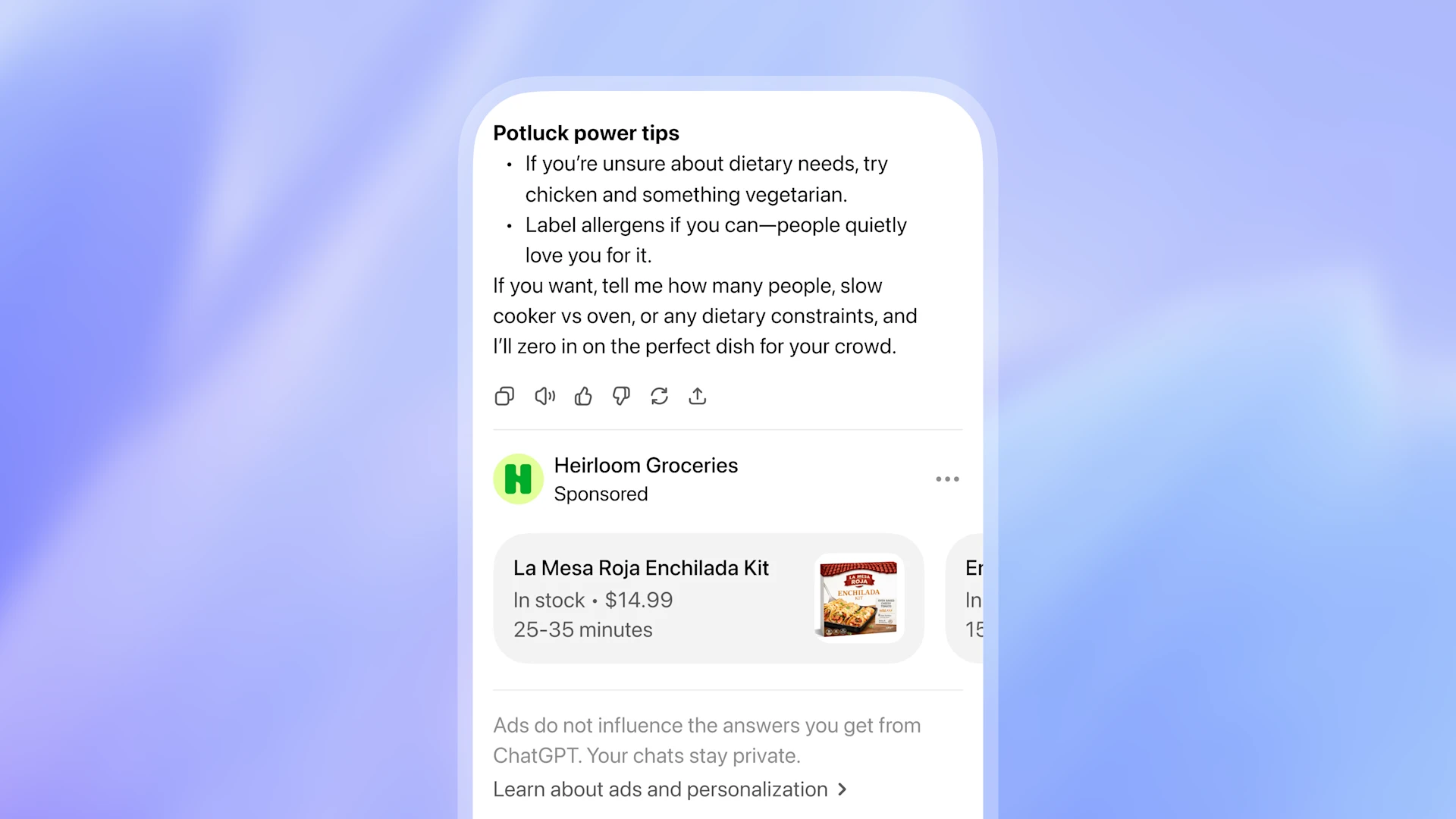
ChatGPT Ad: example from openai.com
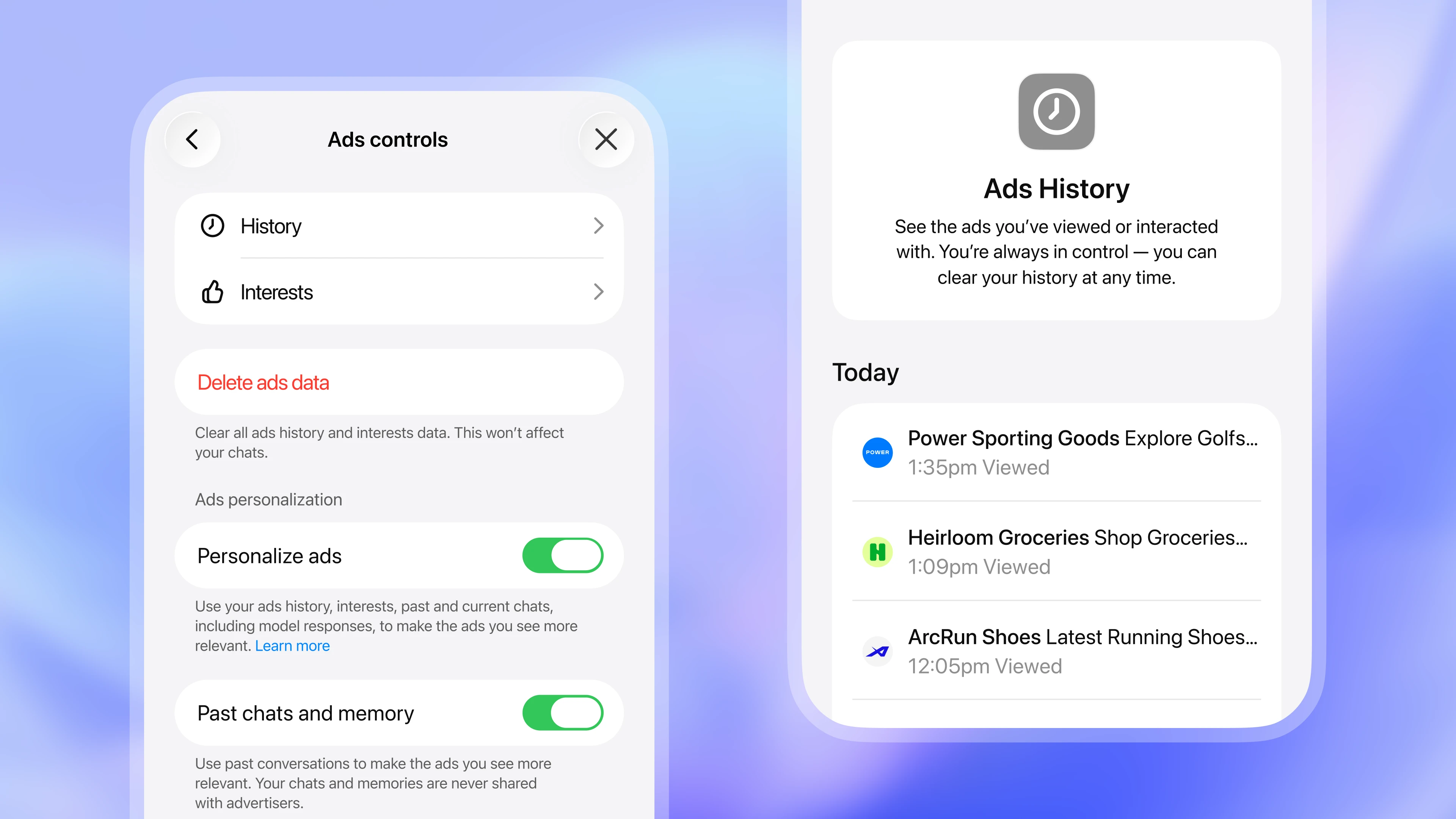
Users keep full control: they can skip ads, share feedback and understand why they are seeing a particular ad.
Personalisation can apparently be configured as well.
Settings of that kind may be familiar from other ad platforms such as META.
Ad personalisation controls — openai.com
Anyone interested in the ads can join a kind of waitlist.
When the rollout in Germany would follow was not public at that point.
26.01.2026:
A premium environment with limited measurability
OpenAI deliberately positions ChatGPT Ads as a high-priced premium ad format inside AI conversations. Prices are reported at around $60 per 1,000 impressions — well above classic social or search CPMs. At the same time advertisers initially receive only heavily aggregated performance data, such as impressions or clicks, with no detailed insight into downstream conversions or purchase decisions.
That creates a new trade-off: ChatGPT Ads offer access to a highly attentive, contextual environment, but require accepting limited attribution. OpenAI justifies this with a clear focus on privacy, brand safety and trust — including the commitment not to sell conversation data and to fully exclude sensitive topics and minors.
In this early phase, ChatGPT Ads are therefore less a classic performance channel and more an exploration and visibility instrument. For experiment-friendly brands this opens the chance to collect learnings early in a new AI-driven advertising environment, before scale and advanced measurement models arrive.
22.01.2026:
OpenAI focuses on impressions rather than clicks
Visibility instead of clicks: with the introduction of ChatGPT Ads, OpenAI focuses on impressions inside AI answers. Ads work contextually within the decision process — even without a direct click. Classic performance KPIs have to be rethought.
20.01.2026:
A shift in the measurement logic of digital advertising
With the introduction of ChatGPT Ads, a fundamental shift in the measurement logic of digital advertising is emerging. According to statements around the OpenAI rollout, the focus of this new ad form is not on clicks, but on impressions and visibility inside the AI answer.
Unlike classic search or social ads, ads in ChatGPT are integrated directly into the answer context. Users are in problem-solving or decision mode and often leave the platform without a direct click — even though the ad has already had its effect.
What does that mean for advertisers?
ChatGPT Ads work primarily as an attention and influence channel, not as a classic traffic driver.
The impact often shows up with a delay, for example through later brand searches, direct visits or conversions in other channels.
Classic KPIs such as CTR fall short here; new evaluation models are needed.
Context: AI search
The behaviour is comparable to what can already be observed in AI-driven search systems:
Users research in LLMs, compare options and make decisions — the conversion often happens later and outside the AI platform.
16.01.2026:
OpenAI announces it will test ads in ChatGPT in the coming weeks
Initially for Free and Go users in the US. This changes how attention, intent and buying decisions are formed. Conversion rates inside the user journey of AI users are already remarkably high. Through ads, brands gain access to prominent placements inside a platform used by millions. We help you build the foundations now, so you can start the moment the channel becomes available for your setup.
What we know so far
OpenAI has defined several guardrails that matter for anyone planning ahead:
Ads do not influence answers: advertising is separated and clearly labelled, answers remain “helpfulness-first”.
Placement: ads sit below the answer, and only when a sponsored product or service is relevant to the conversation.
Plans: ads run on Free and Go. Ad-free are Plus, Pro, Business, Enterprise and Edu.
Privacy & Control: conversations are not sold to advertisers; users can hide and report ads, see why they appear, disable personalisation and delete their ad data.
Safeguards: no ads on accounts identified as minors, none in temporary chats or the Atlas browser, and none adjacent to sensitive topics such as health, mental health or politics.
What advertisers get in terms of data: impressions, clicks, spend, CTR, average CPC, average CPM and conversions — aggregated only. No chats, no transcripts, no personal data.
OpenAI launched the Atlas web browser at the end of 2025, which can potentially generate user data. Market penetration does not feel high yet.
Even so, ChatGPT collects very strong usage signals through interaction, which will allow ads to be targeted precisely.
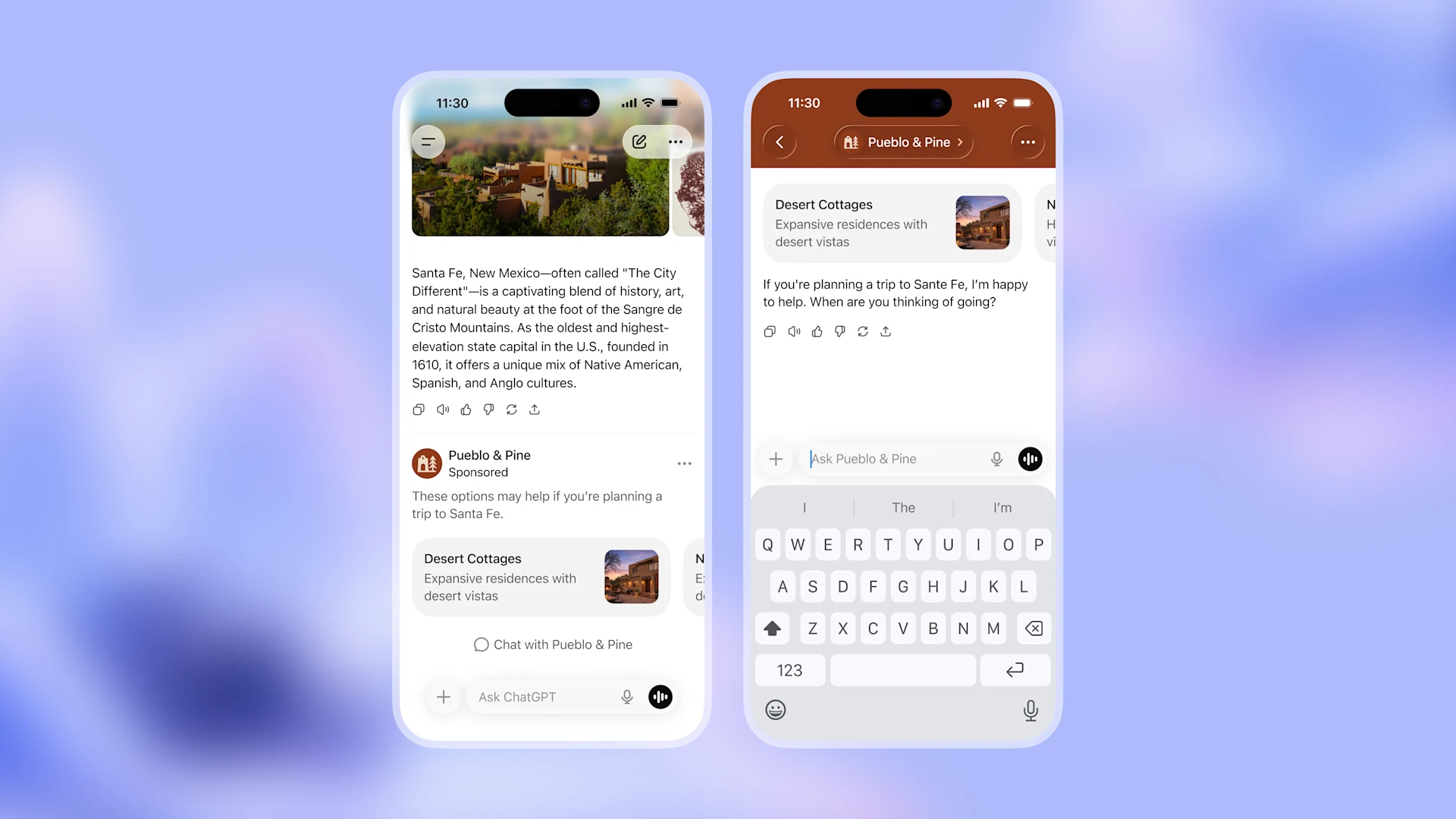
ChatGPT Ads example from openai.com
What you can do now (before you release the first budget)
Self-serve access is open – in the US since May, in Europe since 31 August 2026: advertisers of every size open an account themselves, with no minimum budget.
Alongside that, the route via OpenAI’s Ads Solutions team and agency and technology partners remains. The guide further up shows what a test of your own looks like.
Either way, it pays to work through the essential building blocks of AI search first:
Entity and product pages: do grounding pages exist? Are brand, services and founders defined?
What does the product catalogue look like? Google has introduced UCP, and it is fair to assume ChatGPT Ads will also rely on a feed that exposes structured product attributes, for example via JSON-LD.
How solid are the brand’s AEO and GEO foundations? Have the essential AI Search Optimization to-dos been implemented?
Are basic tracking tools in place, such as simple post-purchase surveys? Beyond tracking, that is what makes the impact of these measures measurable at all.
Are prompts already being captured and tracked with a tool?
Concrete measures you can start today:
Offer readiness: now that ChatGPT Ads are live, the winner won’t be the loudest creative — but the clearest offer: why are we the best option, and why now?
Intent map for conversation queries: what do users really ask before they buy? (Comparisons, alternatives, “best for”, objections, price and value logic.)
Product feed readiness: the newer campaign types — oCPC and the multi-product carousel — run on product feeds. Missing attributes, thin product detail pages and unclear USPs do not get prettier in a chat, they get invisible.
Landing page & proof system: conversation ads only perform if trust and conversion line up: proof, FAQs, transparency, brand authority and ultimately the landing page itself.
Data, tracking & compliance by design: set tracking up so you are not optimizing blind later: clean events, consent logic that also covers enhanced matching, an attribution setup and a CRM loop.
What are ChatGPT Ads?
In January it was only known that ads would appear at the bottom of answers, and only when they fit contextually. The formats are documented by now: advertiser name, favicon, headline, description text, image asset and landing page URL, plus a format with a larger image and an optional CTA button, and since August 2026 a multi-product carousel for product feed campaigns. The substance of the answers is still not manipulated.
ChatGPT Shopping Ads were at least discussed at one point, and brands could submit their product feed. From our own observation, those requests were never answered.
Sponsored recommendations can be ruled out based on the latest announcements, and would seriously endanger ChatGPT’s relevance.
Branded custom GPTs and tools are already a proven instrument for brands and SaaS companies, but essentially still have nothing to do with the ads manager.
Sponsored content in the GPT Store could be rolled out in a similar way to the app stores.

















_format(webp).webp)









.png)